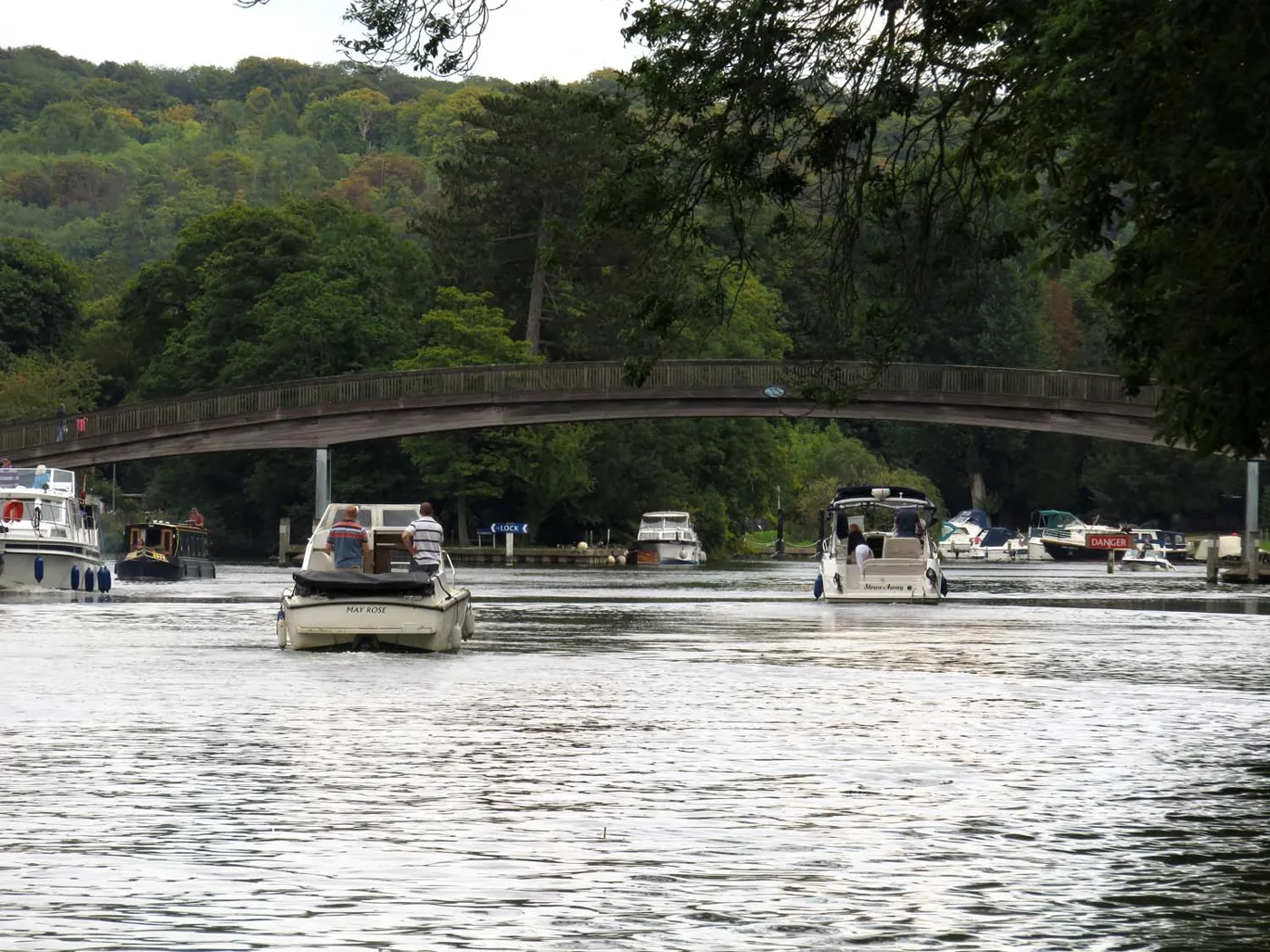

A new Temple Footbridge near Marlow would cost about £10m and has no funder, so a Thames Path route over Hurley Weir is favoured. Feedback closes 30 October.
Replacing Temple Footbridge, the closed Thames crossing about two miles upstream of Marlow, would cost in the region of £10 million, and nobody has the money. The Environment Agency, which owns it, says its own budgets cannot pay for it.
Instead, the agency is backing a cheaper plan. The Thames Path would cross the river at Hurley Weir instead. That would cost up to £30,000 and could be open within a year.
The figures come from the display boards the agency showed at a public information event on Friday 16 October (Environment Agency, Temple Footbridge event posters, October 2026). Its online feedback form stays open until Friday 30 October.
Why the bridge cannot be repaired
The timber bridge opened on 24 May 1989. It completed a 16-mile stretch of the Thames Path National Trail, and it had a design life of about 30 years. The agency closed it on 15 May 2023 over structural and safety concerns (Environment Agency, Thames area assets: Temple Footbridge).
Since then:
- the central span was lifted out in November 2025 and taken to the agency’s depot at Caversham
- that span was assessed and found to be beyond economical repair
- the two side spans were inspected in February 2026 and found to be in very poor condition, with decay in the main beams, deck boards and parapets
- the agency concluded that refurbishing them is not viable either
So the choice is a new bridge or a new route.
The £10m bridge
The agency says a replacement built to modern design standards “will be a substantial construction project, likely to cost in the region of £10m”. Its boards put the cost at up to £10 million, with the funding source and timescale “unknown”.
The reason is the rules on its money. Environment Agency funding has to go on operational assets, the ones that exist for flood risk, water resources or navigation. A footbridge for walkers is none of those, so it does not qualify. The agency says it would support another organisation, private or otherwise, taking on the bridge and its upkeep.
The Hurley Weir route
The Thames Path Partnership has proposed the alternative. The agency says it is “the quickest and most cost-effective solution”.
| New bridge | Hurley Weir route | |
|---|---|---|
| Cost | Up to £10 million | Up to £30,000 |
| Funding | Source unknown | Not stated |
| Timescale | Unknown, until funding is found | Could be operational within a year |
| Next step | Design, consultation and planning | Landowner consents and works at access points |
The route would cross the Thames at Hurley Lock and weir. It would then follow footpaths north of the river near Harleyford Manor and rejoin the river upstream of Temple Lock. Much of it uses existing public rights of way, but one section would be a new permissive path.
It is not a done deal. Walkways over the weir would need widening and better access, and the route would not open until that work is complete. The partnership still needs landowners’ permission. The agency says landowners “should not feel under any pressure to accommodate a route”, and that any option would need to work around their needs.
If the route goes ahead, the agency says local people, councils and other groups will be consulted. It adds that the new route could be an interim answer, leaving room for a bridge later.
The detour today
Walkers currently divert through Bisham village and rejoin the Thames Path at Marlow Bridge. The agency measures that detour at 3.64km. The nearest bridge upstream is at Henley, 10.85km away.
What it means for you
- If you walk or run this stretch, the Bisham diversion stays in place for now. Even the cheaper route needs consents and works before it opens.
- If you want a say, the agency’s Temple Footbridge page links to its feedback form, open until Friday 30 October. You can also email enquiries_thm@environment-agency.gov.uk.
- If you hoped for a new bridge, the agency’s position is plain: it will not fund one, and a replacement would take “as long as it takes to secure third party funding”.
The bridge itself has a local history. It was built after a campaign that began with a public meeting in 1970, when the Temple ferry had stopped running in 1953. Money came from local donations, councils, charities and companies, and Thames Water built it. That is the model the agency is now, in effect, inviting someone to repeat.
For other closures and diversions around the area, see our High Wycombe roadworks and travel page.
Have your say