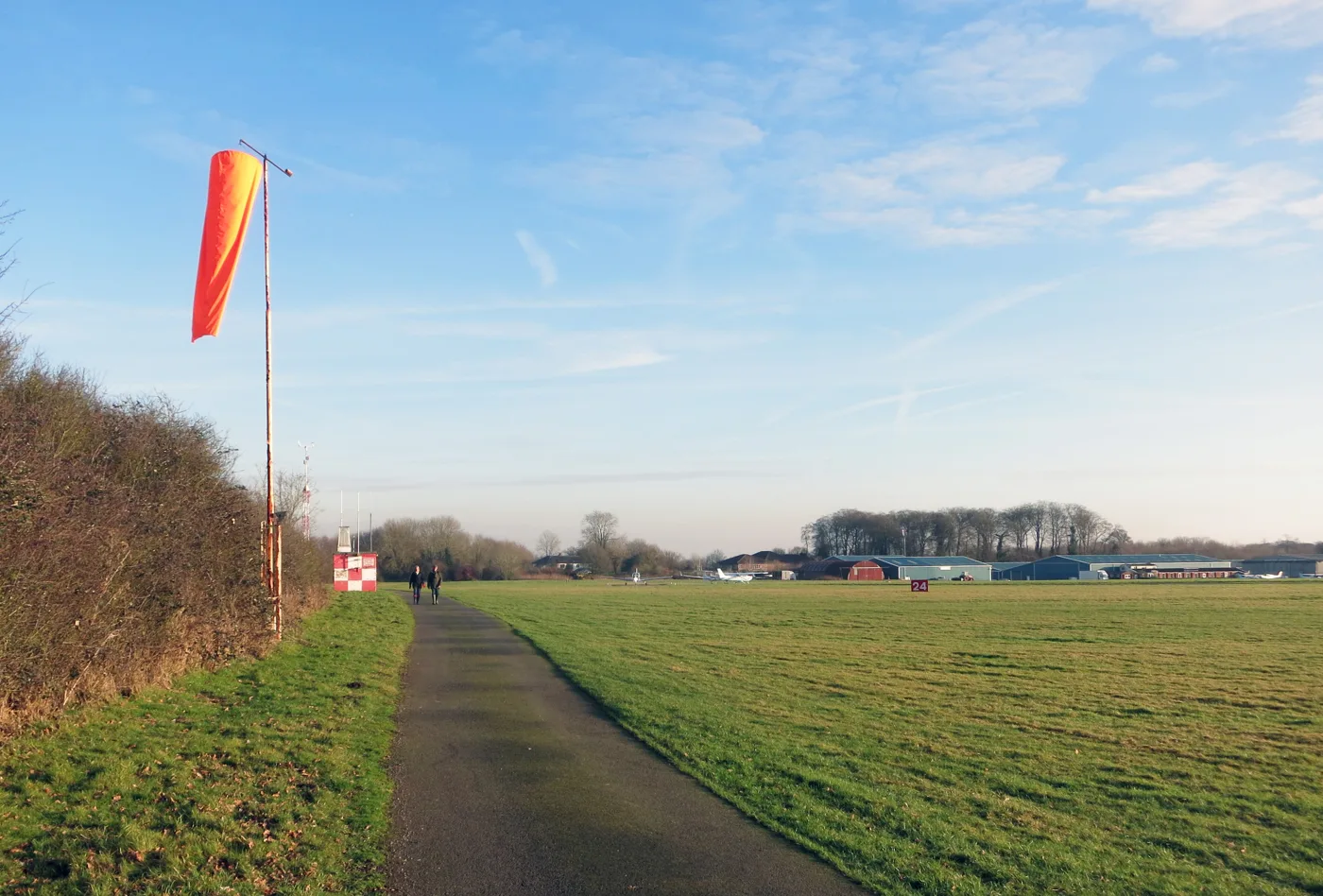

Councillors backed six data halls at Booker by eight votes to nil on 2 September. No permission has been issued and the minutes are still unpublished.
Buckinghamshire Council’s Strategic Sites Committee voted unanimously on Wednesday 2 September to back a data centre on 13 hectares at the southern corner of Wycombe Air Park, Booker. All eight councillors present voted for it.
Ten days on, planning permission has not been granted. The council’s own planning register still records application 24/07967/OUT as “Registered”, with the decision printed date shown as not available, when we checked it on 12 September. That is by design rather than delay: officers recommended that the committee be “minded to grant” and then defer the decision until a legal agreement is signed. Until that agreement exists, there is no permission.
The minutes of the meeting have not been published either. The only public record of what was said is the council’s own webcast.
What was backed
The application is in outline, with every detail reserved for later. What councillors agreed in principle was:
- a data centre of use class B8, with ancillary offices, on a site of about 13 hectares
- a development area of 9.2 hectares inside that
- a maximum building height of 20.5 metres, rising to 20.5 metres plus a further 3 metres of plant over part of the site
- an illustrative layout showing six large data halls, which the report is careful to say is not the definitive basis for judging the scheme
- a new access and junction onto Marlow Road, alongside the existing air park access from Clay Lane
The applicant is Wycombe Park Ltd. The case officer was Emma Crotty.
Where it is, and who owns it
The site sits at Booker, on the western edge of High Wycombe. It is about two and a half miles from the town centre in a straight line, and it is in the Chiltern Villages ward and the parish of Great Marlow, not in High Wycombe itself. Clay Lane runs along one boundary and Marlow Road along the other. The nearest homes, at Claymoor Park, are 50 metres from the site boundary.
One detail explains why this went to the Strategic Sites Committee at all rather than to a local area committee. Buckinghamshire Council owns the airfield freehold. The officer’s report says the application was heard by that committee “because the Council is the freehold owner of the land”. The council is both the landowner and the planning authority here.
The airfield keeps flying. The report puts Wycombe Air Park at about 90,000 flight movements a year, and an aviation report submitted with the application concluded the development would not compromise it.
The jobs question, and the answer officers gave
This was the argument that ran through the objections, and officers met it head on.
The applicant’s economic statement claims:
- 2,282 temporary construction jobs within Buckinghamshire, and 4,144 nationally
- construction value added of £116.0m in Buckinghamshire
- 1,027 full-time equivalent jobs supported during operation in the county, and 4,638 nationally
- about £24.7m in wages and roughly £4.4m a year in business rates
The number that matters locally is smaller. The operational workforce would be about 300 full-time equivalent jobs. The report concedes this plainly: it is “lower than may be expected from some alternative employment-generating uses on an allocated strategic employment site”.
The site already has permission for the alternative. The committee approved an eight sound stage film studio here in February 2025, and that permission is the fallback if the data centre is never built.
There is one line in the applicant’s case worth holding on to. Among the benefits listed is “the development of a cluster of data centres in the High Wycombe area, which will bring agglomeration effects to existing and future data centres nearby”. This application is presented as the first of several.
Power and water
Two figures answer the questions residents asked.
On power, the update report published the day before the meeting confirms the applicant has a firm connection offer from SSEN of more than 50 MVA. Officers found no evidence of an energy infrastructure constraint that would prevent the development.
On water, the design decides the argument. The data centre would be air-cooled, not water-cooled. The applicant’s foul water and water supply strategy is built on an operational population of 300 people and concludes there would be no significant process water demand.
That does not mean Thames Water is content. It has identified constraints in the potable water supply network and is concerned the development could cause low water pressure or insufficient supply capacity, so it asked for a condition requiring either network upgrades or an agreed phasing plan before anyone occupies the buildings. Its position did shift between the main report and the update: the update records that Thames Water no longer identifies an inability of the receiving sewage treatment works to cope, and one condition was dropped as a result.
Nine comments
For a scheme of this size, the public response was small. The council’s register records 28 people consulted and nine comments received: seven objections, one in support and one neutral. No councillor comments were received at all.
The objections, as officers summarised them, covered:
- 24-hour operational noise from cooling plant, substations and backup generators, and low frequency hum in particular
- emissions from diesel standby generators during testing and power cuts
- the electricity the site would draw, and what new infrastructure that would need
- water consumption for cooling
- the scale and massing of the buildings in views from nearby homes and countryside
- light pollution and dark skies
- the carbon footprint
- that a data centre makes poor use of land released from the Green Belt for employment
- that data centres have a limited lifespan, and what happens to the site afterwards
Environmental Protection did not object in principle but said the applicant had still not provided enough technical detail on the standby generators to assess air quality properly. That is being handled by condition and by a payment in the legal agreement.
What the committee did
The recommendation was proposed by Councillor Mark Roberts and seconded by Councillor Jonathan Waters, and carried on a show of hands with all eight members in favour. The eight councillors listed on the webcast are Alex Collingwood, who chaired, Patrick Fealey, Kathy Gibbon, Phil Gomm, David Moore, Mark Roberts, Gregory Smith and Jonathan Waters.
The tone was not enthusiastic. Members said they could see no planning reason to refuse, that residents would be disappointed to get a data centre rather than a film studio, and that the site’s fallback permission for sound stages was more intrusive than what was now proposed. One member asked for the scheme to come back to committee at reserved matters stage because the landscaping and the green walls were the part that mattered. The meeting was also the last for Chris Steuart, the council’s team leader for development management, who is retiring.
We have not quoted anyone word for word. The council publishes automatically generated subtitles for its webcasts, and they contain obvious transcription errors, so they are sound enough to establish what happened and not sound enough to quote.
How long this has taken
What happens next
Three things have to happen before anything is built.
- The section 106 agreement. It has to secure travel plan monitoring, a speed survey, funding and implementation of a Traffic Regulation Order to cut the speed limit on Marlow Road, and a payment to offset air quality damage, including limiting the number of backup generators and using the cleanest non-diesel technology available. The applicant has confirmed it is willing to sign.
- The decision notice. Only once the agreement is completed can officers issue the permission, with conditions attached. One of those conditions would restrict the buildings to use as a data centre and nothing else.
- Reserved matters. Appearance, landscaping, layout, scale and access are all still to come, in separate applications. Nothing about how these buildings will look has been settled.
The scheme is also required to deliver a 10% net gain in biodiversity and policy-compliant tree canopy cover.
What it means for you
If you live at Claymoor Park, on Clay Lane or on Marlow Road, the decisions that affect you most have not been made yet. Noise limits, generator numbers, lighting, building appearance and landscaping are all still to be fixed, by condition or at reserved matters. Those are the stages to watch, and each one is consulted on separately. You can follow the case by searching reference 24/07967/OUT on the council’s planning register.
If you drive Marlow Road, expect a speed limit reduction to be consulted on as a separate Traffic Regulation Order, paid for by the developer. We track live closures and orders on High Wycombe roadworks and travel.
If you object to development of this kind, the ground has moved. The National Planning Policy Framework published on 17 August 2026 sets out government support for data centres as digital and AI infrastructure, and expects councils to plan positively for them. Officers gave that substantial weight here, and gave only moderate weight to the harm to the setting of the Chilterns National Landscape. That balance is now the starting point for the next application, not the end of this one.
We keep a running record of decisions in the district on High Wycombe planning news.
Frequently asked questions
Has the Wycombe Air Park data centre been approved?
Not yet, in the strict sense. The Strategic Sites Committee voted eight to nil on 2 September 2026 to be “minded to grant” it and to defer the decision until a legal agreement is signed. As at 12 September the council’s planning register still shows application 24/07967/OUT as “Registered” with no decision notice issued.
Where exactly would it be built?
On about 13 hectares at the southern corner of Wycombe Air Park at Booker, bounded by Clay Lane and Marlow Road. That is roughly two and a half miles west of High Wycombe town centre, in the Chiltern Villages ward and the parish of Great Marlow. The nearest homes, at Claymoor Park, are 50 metres from the site boundary.
How many jobs would it create?
About 300 full-time equivalent jobs once operating. The officer’s report accepts that is lower than other employment uses would deliver on the site. The applicant also claims 2,282 temporary construction jobs in Buckinghamshire and around £4.4m a year in business rates.
Would it use a lot of water?
The scheme is air-cooled rather than water-cooled, and the applicant’s strategy is based on an operational population of 300 people with no significant process water demand. Thames Water still has concerns about potable water pressure and supply capacity and has asked for a condition requiring network upgrades or a phasing plan before occupation.
How much electricity would it need?
The applicant told the committee it holds a firm connection offer from SSEN of more than 50 MVA, which officers accepted as sufficient for a data centre operation.
Sources
- Officer’s report to the Strategic Sites Committee, 2 September 2026, application 24/07967/OUT for the site area, heights, ownership, employment figures, objections, section 106 heads and the weighing of harm and benefit.
- Update report to the same meeting for the SSEN connection offer, the revised Thames Water position and the deleted condition.
- Agenda for the Strategic Sites Committee, 2 September 2026 for the meeting, its venue and the webcast, and the committee’s meeting list which shows no minutes published for 2 September.
- Buckinghamshire Council’s webcast of the meeting, including its automatically generated subtitles, for the proposer, the seconder, the show of hands and the eight members present.
- Buckinghamshire Council’s planning register entry for 24/07967/OUT, read on 12 September 2026, for the application status, the dates, and the count of comments: 28 consulted, nine received, seven objections, one in support.
Have your say
Robert Davey 17 September 2026
No mention is made of the likely traffic chaos for getting the electricity connection. I live in Farnham Royal and data centres are being built on the Slough Trading Estate. We have had months of road closures, one way operation controlled by traffic lights. I had thought this work was finished, but today the connection would seem to be being made between Park Road and Farnham Lane, crossing the A355 at the "Farnham Pump" mini roundabouts. This is causing traffic queues in all directions.