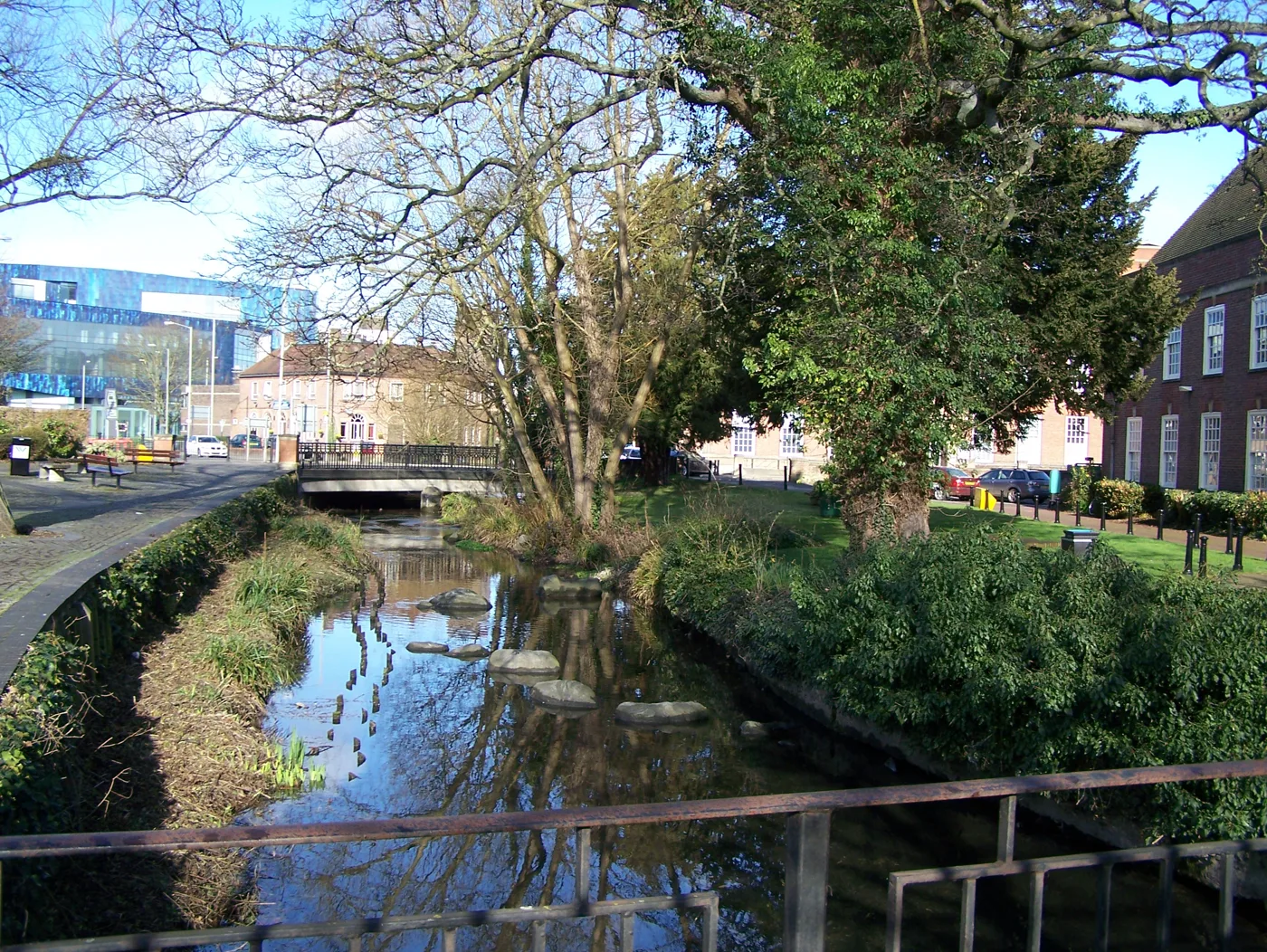

The Fire Authority voted £8m to refurbish the 1966 station, not replace it: a new station in Flood Zone 3 might never get planning permission.
High Wycombe’s fire station is getting an £8 million overhaul rather than a new building, and the reason is the river next to it.
The Buckinghamshire & Milton Keynes Fire Authority approved a capital budget of £8 million at its meeting on Wednesday 16 September, for what its own papers call a “comprehensive refurbishment and reconfiguration” of the station on its existing site. The Authority announced the decision the next day.
The press release describes an investment in welfare facilities, decontamination and energy efficiency. The business case behind it, published in full in the meeting’s public agenda pack, says something the release does not. A replacement station on that site might not be allowed at all.
Why it is a refurbishment and not a new station
The station, which opened in 1966, sits beside the River Wye in Flood Zone 3. The business case sets out what that means in planning terms:
- Fire stations that must stay operational during flooding are classed as Highly Vulnerable development.
- Mapping in Buckinghamshire’s Strategic Flood Risk Assessment shows Flood Zone 3b, the functional floodplain, running along the river corridor at the site.
- In the report’s own words, “a replacement station within Flood Zone 3 is not guaranteed to obtain planning permission”.
Refurbishment keeps the existing use and the existing structure, which the report calls “the more robust planning route”. Five options were assessed, including partial rebuilding, full demolition and rebuilding, and a new station somewhere else. The site is also caught up in town centre regeneration proposals.
A structural survey completed on 10 July 2026 found the main structure still serviceable, and concluded that with the recommended repairs the building could last at least another 50 years.
What the £8 million is actually for
The financial appendix breaks the figure down. The forecast total is £7,993,527, and the Authority was asked for a round £8 million.
| Item | Cost |
|---|---|
| Construction | £5,994,606 |
| Decant and temporary site | £700,000 |
| Project contingency, 15% | £899,191 |
| Project consultancy, 5% | £299,730 |
| Project staffing | £100,000 |
| Forecast total | £7,993,527 |
The money comes from the Authority’s capital reserves. The report is careful about what the figure is: an “order-of-cost assessment rather than a tendered construction price”, with a decant estimate that “contains unknown elements”.
The condition of the building
The evidence section of the business case is blunter than the press release. It records:
- a maintenance and condition backlog of about £458,000, from the 2022 estate condition survey, described as “the largest station-level increase in the estate backlog”
- more than 200 defects and maintenance requests logged at the station in the last two years, across appliance bay doors, washrooms, welfare and the whole building electrical installation
- drainage runs that have lost up to 70% of sectional area through deposits, with surface water discharging towards the River Wye with no separator
- asbestos insulating boards, flash guards and “a significant amount of ceiling tiles” confirmed as containing asbestos
- spalled and cracked concrete, corroding reinforcement, masonry cracking and flat roof deterioration
Doing nothing would still cost about £458,000 in maintenance, on a survey that is now four years old. The report says an updated survey is due and is likely to find more.
The approval has a condition attached
This is not a final go-ahead for a refurbishment. The business case says approval of the preferred option “would remain conditional on the Stage 3 design demonstrating that all mandatory operational, contaminants-control, EDI, accessibility, environmental and structural requirements can be achieved within the retained building”.
If the designers cannot show that, the partial rebuild option goes back to members before the main construction contract is awarded. In other words, the £8 million buys the design work that decides whether refurbishment is possible at all.
Where does the fire engine go?
The part still unresolved is where High Wycombe’s crews work while the station is being rebuilt around them. The report is candid about it:
- Temporary sites discussed with Buckinghamshire Council are currently car parks, and would need significant investment to take a modular building.
- Initial inspections indicated the location or size of those car parks “may be insufficient to meet operational requirements”.
- Talks with private landowners “have not progressed”, because temporary occupation is not expected until the start of 2028 and landlords will not commit that far ahead.
- The Authority will ask bidders to propose a phased build, so part of the station could stay in use and shorten or remove the need for a temporary base.
One assumption in the report is that a temporary solution can be found in High Wycombe, “supported by Marlow where operationally approved”. Marlow is the next fire station south of the town.
High Wycombe is one of seventeen fire stations covering more than 800,000 people in Buckinghamshire and Milton Keynes, with twenty-four pumps between them.
Three different finishing dates
The papers do not agree on when this ends, and neither does the press release.
- The cover paper to the Authority says the programme anticipates “occupation by October 2028”.
- The programme table inside the business case puts final commissioning, staff familiarisation and occupation in March 2029, after main works running from July 2028 to February 2029.
- The press release says the refurbished station “is expected to be occupied by during 2029”.
The nearest thing to a fixed date is the next step. Pre-application planning engagement and design work were due to start in September 2026, with a planning submission and Environment Agency engagement between January and June 2027, and a planning and investment readiness review by June 2027. A planning application for the station will therefore be a public document, and will appear on the council’s register like any other. We track those on High Wycombe planning news.
What it means for you
- Emergency cover is not changing now. Nothing happens on site before 2027 at the earliest, and the report requires operational response to be maintained “within Service-approved tolerances” throughout.
- The decant is the thing to watch. If the temporary station lands on a town centre car park, that affects parking as well as fire cover. Current charges are on parking in High Wycombe.
- You will get a say through planning. The refurbishment needs planning permission and Building Regulations approval, and a Flood Risk Assessment agreed with the Environment Agency.
- The £8 million is a ceiling, not a price. The Authority approved it as “a defined affordability ceiling” while the design is worked up, and the construction cost has not been tendered.
Sources
- Fire Authority approves High Wycombe Fire Station refurbishment project, Buckinghamshire Fire & Rescue Service, published 17 September 2026, for the decision, the planned improvements and the quotes from Chief Fire Officer Louise Harrison and Authority chair Llew Monger.
- Buckinghamshire & Milton Keynes Fire Authority, 16 September 2026, agenda and reports, Item 9, for the cover paper and its recommendations, Appendix 1 the business case and Appendix 2 the financials. The lead member is Councillor Niknam Hussain, the report sponsor is Asif Hussain, Head of Finance and Assets, and the author is Laura Power, Property Manager.
- Appendix 1 of the business case for the 1966 opening date, the 10 July 2026 structural survey, the Flood Zone 3 and River Wye planning analysis, the condition evidence, the decant position, the programme table and the seventeen stations and twenty-four pumps figures.
- Appendix 2 of the business case for the cost breakdown and the £7,993,527 forecast total.
Read on 23 September 2026. Minutes of the 16 September meeting had not been published when this was written; they are normally approved at the following meeting, which is due on 2 December 2026.
Have your say