
Government approval of Buckinghamshire's SEND plan should clear about £41m of a £45.5m deficit. In 2025 it issued 7.8% of new EHC plans within 20 weeks.
The Government has approved Buckinghamshire Council’s plan for special educational needs and disabilities (SEND). The council announced it on Thursday. Its release talks about earlier support for children. It does not mention the money that approval unlocks.
That money is a one-off grant of about £41 million, which should wipe out most of the council’s SEND deficit. Approval of a local SEND reform plan is the condition for getting it.
The plan
The council’s announcement of 15 October says its three-year Local SEND Reform Plan will include:
- making schools and early years settings more inclusive and better equipped for children with SEND
- more support for children and families while they wait for assessments or diagnoses
- a better experience for families who need help from SEND services
- stronger specialist support for children with more complex needs
The Department for Education described the plan as “a clear and coherent vision centred on inclusion, earlier intervention and improved outcomes”, the council said.
Carl Jackson, the Cabinet Member for Education and Children’s Services, said: “I do not want parents to feel they have to fight for the support their child needs.” He added that families and schools “can expect to see more changes introduced over the next two to three years”.
The money
SEND support in schools is paid for from the high needs block of the Dedicated Schools Grant, which comes from the Government. In Buckinghamshire it has been spending more than it receives.
A report to the county’s Schools Forum on 30 June set out the figures (Buckinghamshire Council, DSG outturn 2025-26):
- the deficit stood at £24.5m at the start of April 2025
- the year added £20.98m
- that left a deficit of £45.5m at 31 March 2026
The Government announced the High Needs Stability Grant in February. The report says it is expected to pay 90% of the cumulative deficit, but only once a local SEND reform plan has been approved. The council estimated its grant at £40.95m, which would leave £4.55m of the deficit. The grant must be used only to clear it.
The grant deals with the past. The high needs budget for 2026-27 was set with a further projected deficit of £30.3m, and that figure already counts on £13.07m of savings, a second report to the same meeting says (Buckinghamshire Council, DSG savings plans 2026-27). Those savings rely in part on keeping more children in mainstream schools rather than special or independent ones.
The waiting
The release promises support “when they need it”. The latest national figures show how far the county is from that.
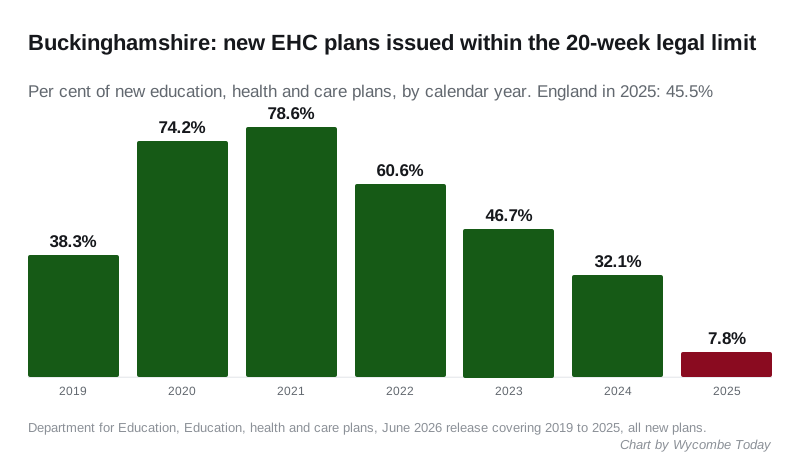
An education, health and care (EHC) plan sets out the support a child is legally entitled to. The law says a new plan should be issued within 20 weeks of the request. In 2025, Buckinghamshire issued 54 of 696 new plans on time, or 7.8%, according to the Department for Education’s EHC plan statistics published in June.
The same figures show:
- an average of 54.4 weeks to issue a new plan, more than two and a half times the legal limit
- 379 plans that took more than a year
- a rate of 32.1% in 2024 and 78.6% in 2021
- England at 45.5% and the South East at 46.2% in 2025
Of the 150 councils with a published rate for 2025, Buckinghamshire ranks 142nd. It is last of the 18 in the South East.
The council’s own finance report gives part of the reason. It refers to an “accelerated clearance” of the EHC plan backlog in 2025-26. A plan issued from a backlog is already late, so clearing old cases pulls the on-time rate down. The council started a SEND Recovery Programme at the end of January 2026 to speed up assessments, backed by £3m over two years, the June report says. The national figures for 2026 will show whether it has worked. They are due next June.
What it means for you
- If you are waiting for an EHC needs assessment or a plan, the 20-week limit is a legal duty, not a target. Families can complain to the council and then to the Local Government and Social Care Ombudsman.
- If your child goes to school in the Wycombe area, the plan’s changes are meant to arrive over two to three years. The council says implementation “is already beginning”.
- For the council’s finances, the grant should clear about £41m of past overspending, but the 2026-27 budget already expects another £30.3m deficit on SEND.
The Schools Forum next meets on 3 November. School holiday dates are on our term dates page.
Have your say