
Castlefield and Oakridge has the highest claimant rate of all 49 Buckinghamshire wards at 7.3%. Eight of the county's 11 highest are High Wycombe wards.
Castlefield and Oakridge has a higher share of residents claiming unemployment-related benefits than any other ward in Buckinghamshire. In July 2026, 650 people in the ward were on the claimant count. That is 7.3% of everyone aged 16 to 64 who lives there, against 3.0% across the county as a whole.
The ward covers the Castlefield and Oakridge estates immediately west of High Wycombe town centre. It is the top of a list of 49 Buckinghamshire wards, and High Wycombe takes most of the places near the top of it. Of the eleven wards with the highest claimant rates in the county, eight are High Wycombe wards and three are in Aylesbury:
- Castlefield and Oakridge, 7.3% (650 claimants)
- Totteridge and Bowerdean, 5.4% (440)
- Booker and Cressex, 5.4% (210)
- Abbey, 4.9% (465)
- Marsh and Micklefield, 4.6% (390)
- Terriers and Amersham Hill, 4.6% (355)
- Disraeli, 4.6% (190)
- Sands, 4.4% (205)
The figures come from the Office for National Statistics claimant count for July 2026, published through nomis on Tuesday 19 August. Ward figures were checked against the county total and the 49 wards sum exactly to Buckinghamshire’s 10,680.
The gap inside one district
The spread across this patch is wider than the county average suggests. Chiltern Villages, at 1.4%, has the lowest claimant rate of any ward in Buckinghamshire. Hazlemere is second-lowest at 1.6%. Both sit within a few miles of Castlefield and Oakridge, where the rate is more than five times higher.
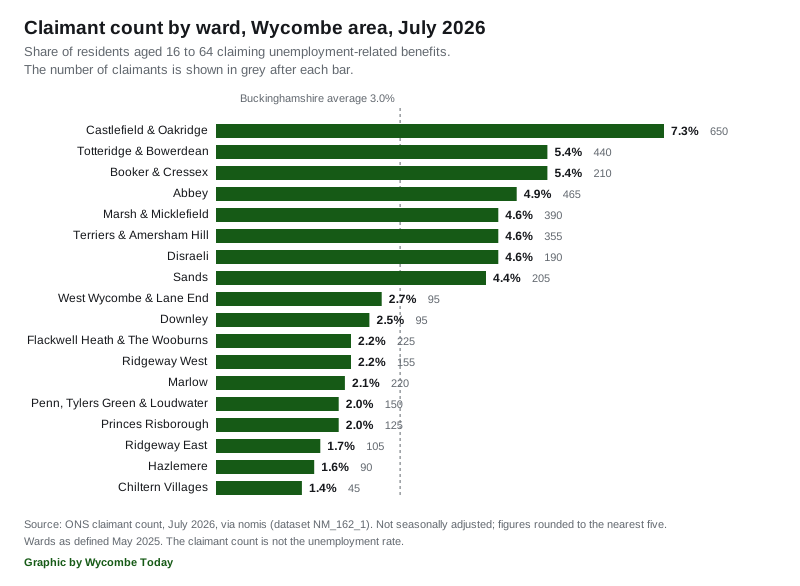
Across the eighteen wards covering High Wycombe, Marlow, Princes Risborough and the villages between them, 4,210 people were claiming in July. That is 39% of the county’s total. Dividing each ward’s claimant count by its published rate puts the same eighteen wards at roughly a third of Buckinghamshire’s working-age population.
The county total fell. The under-25 line did not.
Buckinghamshire’s headline number went the right way. It was 10,680 in July 2026, down 155 on the 10,835 recorded in July 2025, a fall of 1.4%. At 3.0% of 16 to 64-year-olds the county sits just below the South East (3.1%) and well below Great Britain (3.9%).
Underneath that total, two age groups moved in opposite directions:
- 18 to 24: 1,470 to 1,705, up 235, a rise of 16.0%
- 25 to 49: 6,500 to 6,075, down 425, a fall of 6.5%
- 50 and over: 2,860 to 2,895, up 35, a rise of 1.2%
The under-25 rise is the one that stands out, because it is steeper here than in the wider country. Over the same twelve months the number of 18 to 24-year-olds claiming rose 12.2% across the South East and 9.9% across Great Britain. Buckinghamshire beat both.
Stretch it to two years and the shape is clearer still. In July 2024 there were 1,235 people aged 18 to 24 on the count in Buckinghamshire. There are now 1,705. That is a rise of 38.1% while the county total moved by just over 3%.
The three age bands start at 18, so they do not add to the all-ages total, and every figure is rounded to the nearest five.
Ward-level figures only begin in January 2026, so there is no year-ago comparison below county level. Over those seven months the county rose 260, from 10,420 to 10,680. Abbey rose fastest of the local wards in absolute terms, from 425 to 465, and Castlefield and Oakridge went from 615 to 650. Princes Risborough and West Wycombe and Lane End both fell by 15.
What the claimant count is, and what it is not
This is the number most often reported as local unemployment, and it is not the unemployment rate. Nomis describes the series as counting people claiming Jobseeker’s Allowance plus those claiming Universal Credit who are required to seek work and be available for work.
Three things follow from that, and they matter when reading the ward table:
- Some claimants are working. People in low-paid or part-time jobs can be on Universal Credit with work-search conditions attached, and they are counted here.
- The figures are not seasonally adjusted. July always carries school and college leavers who have signed on since the summer term ended, which is why every comparison above is July against July.
- It is a count of claimants, not of everyone out of work. People who are unemployed but not claiming do not appear at all.
What it means for you
If you are out of work in Buckinghamshire, the council’s Connect to Work programme started here in April 2026. It is voluntary, free and one-to-one, and it is aimed at people whose route into work is complicated by a disability, a long-term health condition or another barrier. To qualify you have to be 18 or over (16 if you receive Universal Credit), live in Buckinghamshire, have the right to work in the UK and not already be on another job support programme. You register your interest through an online form and the team contacts you. (Buckinghamshire Council)
Skills Bootcamps and adult learning courses are run by the council rather than by Jobcentre Plus, and are listed on its skills, opportunities and employment pages alongside the Bucks employment support tool. The council has held jobs, skills and opportunities fairs in Aylesbury, High Wycombe and Chesham; the date of the next one has not been set.
If the reason for claiming is a drop in hours rather than losing a job, the Universal Credit work-search rules are the part that puts you into these figures. The conditions attached to a claim, and how they change when earnings change, are set out on gov.uk.
For what the same households are paying to live here, see our page on High Wycombe house prices, and for the cost of commuting out of the town, High Wycombe train times to London.
Sources
- ONS claimant count, July 2026, dataset NM_162_1 via nomis, for ward, county, regional and Great Britain figures, all measure 1 (count) and measure 2 (proportion of residents aged 16 to 64), not seasonally adjusted.
- Nomis claimant count source description, for what the series counts.
- Ward boundaries are those defined in May 2025. Ward-to-postcode checks were made against postcodes.io.
- Buckinghamshire Council, Connect to Work programme and skills, opportunities and employment.
Figures were pulled from nomis on 22 August 2026. The next monthly release covers August 2026.
Update, 16 September 2026: nomis has since revised the July 2026 figures. Buckinghamshire’s July total is now 10,500 rather than the 10,680 reported here, and Castlefield and Oakridge’s July count is now 630, a rate of 7.1%, rather than 650 and 7.3%. Other ward figures moved by similar amounts. The July release came out on Tuesday 18 August, not 19 August as first stated. The article above reflects the figures as published at the time. The August 2026 claimant count uses the revised numbers.
Have your say